

Metro: Last Light Review

What will the earth look similar later the bombs fall? Can God be in a place without promise? When man'southward desire to survive overrides his morality, is the empire he constructs worth saving?
Those are some of the questions raised by Metro: Final Lite. The (cheery!) commencement-person shooter is Russian studio 4A Games' follow-up to their flawed 2022 gem, Metro 2033. The Metro games are based on the works of author Dmitry Glukhovsky; the first game was based on his novel of the same name, and while the sequel isn't based on a specific work, it direct carries on the first game'south storyline.
The Metro series is set some years after nuclear war has ruined the surface of the World and put an end to civilisation equally we know it. In Russia, survivors take retreated to the Metro, re-forging a bleak semi-existence in the tunnels beneath the city. This is the sort of game that mentions, in its opening cinematic, the very real possibility that God is dead.

Similar Metro 2033, Last Lite tells the story of a soldier named Artyom. The tale stands on its own, though it does assume a fair amount of knowledge of the conflict at the centre of the first game. That disharmonize centers around the mysterious "Dark Ones," freaky-looking humanoid beings who possess psychic powers and terrify the human denizens of the Metro. Last Light assumes that players got the "bad catastrophe" in Metro 2033 and took the option to boom the entire population of Dark Ones into oblivion. The subsequent discovery of a single surviving Nighttime Ane sets the plot of Last Calorie-free in motion.
What follows is a incoherent, well-paced and, aside from a handful of moral choices that affect the story's issue, resolutely linear unmarried-role player story that has Artyom touring the lair of the fascistic Fourth Reich, a compound staffed past a powerful Communist army, and working his way through all manner of spooky catacombs, caves, and numerous jaunts to the surface.

The peaks and troughs of the narrative take been organized with a bully deal of care; the story shifts between non-combat exploration, stealth, all-out firefights, and horror-tinged monster fighting with ease. One moment you'll observe yourself in a factory taking on squads of well-armed soldiers, and soon afterward you'll exist alone in a swamp, facing off against horrible crab-monsters. 4A seems to have taken notes from Half-Life two in a number of places; while there aren't any puzzles to solve, the game'due south pacing often recalls Valve's 2004 masterpiece. The mostly surdy story but truly falters in the concluding act, where a series of revelations stack on meridian of one another so rapidly that vital plot points go half-mentioned and it'south easy to lose runway of what's going on.
Every bit they did in Metro 2033, 4A regularly demonstrates an uncanny mastery of the alchemy of atmosphere. Secret cities bustle and radiate with wretched life, and each location has been crafted with a rare degree of item. There's not much to do in most cities, bated from stopping off to refill your ammunition and maybe customize one of your weapons, but I found myself regularly sidetracked, listening to traders talk about their most recent sorties, or soldiers telling grim tales of survival.
When in the field, y'all tin can carry three guns at a time, along with a varied arsenal of throwing knives, grenades, and other survival equipment. Weapons come in the usual diverseness of attack rifles, shotguns, sniper rifles and pistols, with a few variations. Each weapon can be upgraded with silencers, scopes, sights and stocks, though I found little reason to deviate across my standard silenced pistol/shotgun/set on rifle setup.
That said, the weapons in Final Light are all assembled with an uncommon attending to item, and each one feels and sounds distinctive and memorable. I especially liked my quick-burn shotgun, which held a revolver-like band of shells close to the stock, which Artyom would replace one by one after he fired. And, hooray, the prove-stealing "Bastard" submachine gun from Metro 2033 returns, chewing through its lateral-feed magazine in the aforementioned way my male parent eats corn on the cob.
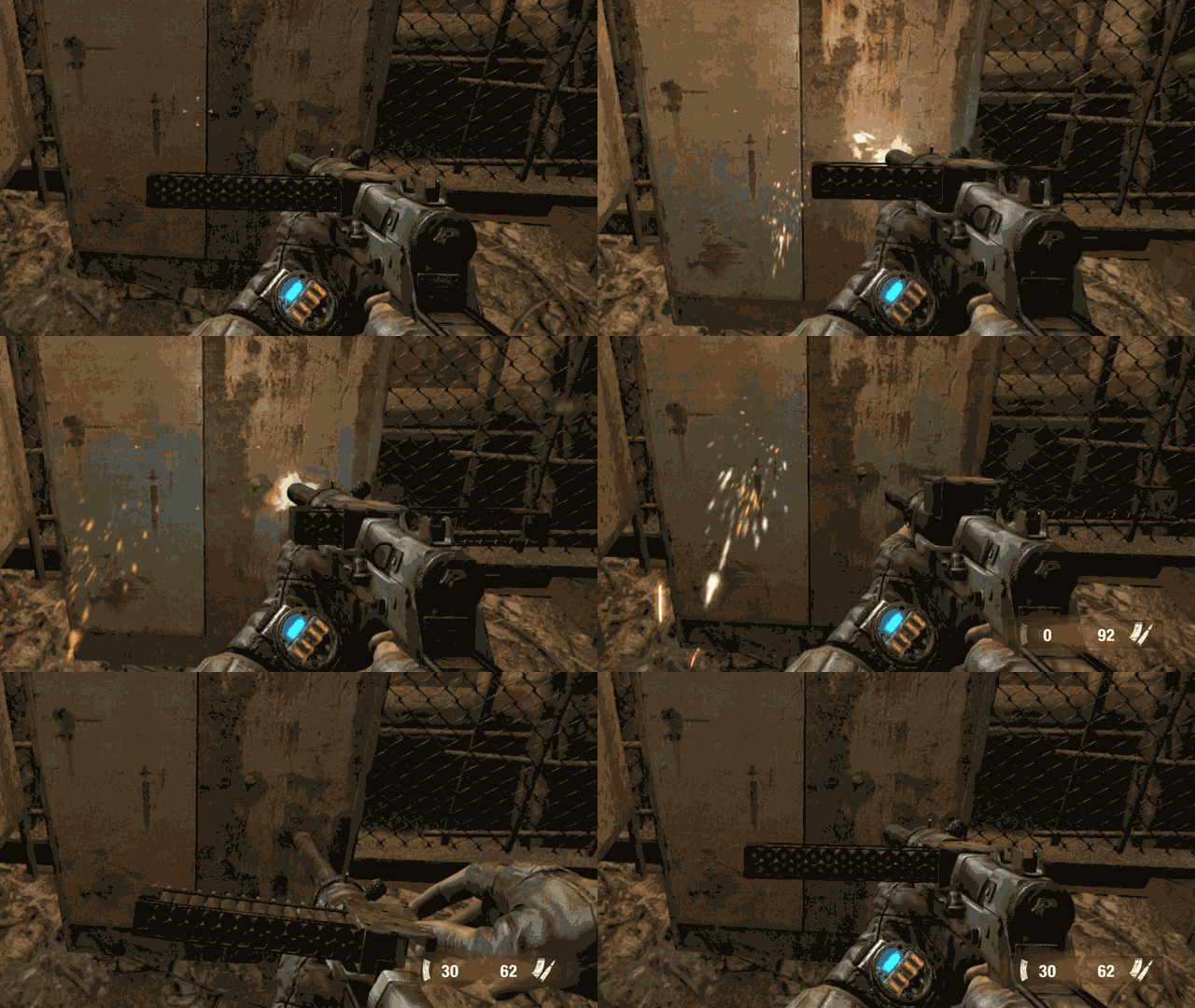
2 of Metro 2033's other most distinctive elements make a welcome return in Final Light: The gas mask, and bullet-based currency. At many moments throughout the campaign, Artyom will have to don a gas mask, either to survive on the toxic surface or to stay live within a gas-filled chamber. It's a wonderfully claustrophobic thing, that gas mask—Artyom's watch displays how much time remains on his electric current filter, and to go along him from suffocating, yous'll accept to regularly change information technology. As his filter degrades, Artyom's breathing becomes increasingly ragged. I ofttimes found that even though I knew I had a minute or more left, I'd swap my filter just to give the poor guy a break.
Instead of coins or bills, the people of the Metro use military-course ammunition as currency. These bullets are kept separate from your "everyday apply" ammo and can be spent to purchase weapon upgrades. Nevertheless, if you're facing off against a dangerous enemy and need more firepower, you can opt to load up a prune of money-bullets and attack for more damage. Woe is you, standing there, firing a clip of coin into an enemy, praying it dies speedily. You may wind upwards bankrupt, just you'll live.
On Normal difficulty, I found that I nearly never ran out of standard ammunition, merely in my limited time with the harder difficulty setting, ammo was much rarer. Hardcore Metro fans will probably want to play this game on its hardest difficult first, saving the actress-hardcore "Ranger Way" for a 2d playthrough. (I did non have Ranger Mode unlocked on my PC build of the game, so I oasis't had a chance to endeavor it out.)

For all its careful pacing and wonderful temper, Last Light certainly has its share of bug. The enemy bogus intelligence is a few steps shy of where information technology would need to be to be truly enjoyable; enemies routinely failed to notice when I'd kill their nearby friends, and more than than once I'd come upon an alerted foe walking into a corner without taking any kind of understandable activity.
The animals and beasts you'll fight are even less nuanced, and normally just accuse at y'all in a straight line. Notwithstanding, the mutant monsters can make for some enjoyable showdowns, just they can also become boring. There are a few boss battles that are every bit unsatisfying; you're generally pitted against behemothic charging bullet-sponges with weak spots, and even 1 rampaging animate being that must exist tricked into bringing down a series of columns in a room. At those moments, the artifice of Last Light shows through the clearest.
While the locations in the game have been crafted with a fine center for item, the characters themselves feel half-formed. You lot'll regularly watch waxen humans talk, slowly turning their unmoving faces toward and away from you like animatronic figures. Terminal Light is a real attestation to the power of skilful lighting and environmental design: The graphical fidelity of the earth tin be remarkably disarming, which stands in sharp contrast to how stilted and unconvincing the characters themselves can exist.
Children, in particular, are a bit freakish, and their vox acting is hollow and odd; not a new trouble for a video game to have, merely certainly one that Last Light doesn't solve. If I'd passed through each area without stopping, I wouldn't have noticed the seams then often. But the game encourages players to stop and listen in to conversations, which ofttimes go along for minutes on end. And then you'll stand, watching as characters stand stock notwithstanding with only their lips moving, zoning out as yous heed to their (commonly quite interesting!) conversations.
Life in the Metro isn't a vacation for the fairer sex, and neither is Metro: Last Light. This is a world filled with men and sexual violence, and virtually every female person character is either a prostitute, a stripper, or a potential rape victim. I don't mean to suggest that a mail service-apocalyptic underground guild wouldn't reveal this sort of barbarism, only the game doesn't handle any of it especially deftly.
One of the only exceptions to the prostitute/stripper/victim-dominion is a female sniper who eventually becomes a love interest, in a rushed storyline that culminates in a stilted first-person lovemaking scene. (Aside from the frequent loading screens, Artyom never actually talks, and so any potential for warmth is immediately torpedoed by his creepy silence.) The scene felt jarring, as did an earlier lap dance from a dead-eyed stripper that had me peering through my fingers in mortification.

Late in the game, a character remarks that "The Metro is a living, breathing thing, with a heartbeat, a soul, and a mind." Indeed, this place feels live; sometimes more so than the men and women who occupy its tunnels.
In fact, Last Calorie-free is often at its best when there'southward no one else around. The psychic powers of the Nighttime Ones play into a running current of mysticism that makes Last Calorie-free'due south Moscow a more mysterious, spiritual place than your average ruined city. The whispers of the dead will call out to you, and scenes of horror and beauty will float upwardly from the by, well-nigh as though the urban center is still crying out in agony. These moments are chilling, and were hands my favorite parts of the game.
So now comes the large caveat: Technical functioning. I played a PC review build of Last Light provided by the game's publisher, Deep Silver. Throughout the game, there's often an underlying feeling that Terminal Light hasn't been stitched together quite right. Granted, I was playing a pre-release build, simply it crashed on me a number of times, ordinarily forcing a complete reboot. In one example, I encountered a bug where upon dying, I reloaded exterior a door with no way to move or put on my gas mask. I had to either watch Artyom asphyxiate over and over or restart the unabridged chapter and lose xx minutes of progress. Triggered events are often cued sloppily or out of sync, directional audio can be jumpy, and the game fifty-fifty difficult-locked on me during the closing credits. One additional technical shortcoming that, while not a bug, remains annoying: The game appears to have only ane save-slot, and when I started a new game on the higher difficulty, it erased all of my progress and left me unable to load whatsoever after chapters. A single save slot, in a PC game? What on earth?
Last Light's PC performance issues are perhaps more than troublesome. I was having some fairly intense issues running the game on an AMD Radeon 6870 (with 8GB of RAM and an i5 3.4Ghz processor), and establish that it ran much more smoothly on my other PC, which runs an Nvidia GeForce 660Ti (with 8GB of RAM and a i5 2.8Ghz). That said, I couldn't go either machine to run the game well on my Television set through HDMI; both games seemed stuck at 24-30 frames per second, no thing which settings or resolutions I chose. The only way to get them to run at a high framerate was to plug them into my PC monitor via DVI.

Late final week, PR advised reviewers to turn off PhysX on AMD cards, which does aid performance, simply the game still feels substantially less optimized for AMD machines. (Last Calorie-free carries the endorsement and branding of Nvidia, the visitor who make GeForce cards, but not of AMD.) On an AMD 6870, it'd generally run at High-to-Very Loftier settings and go on at 40-60FPS, but often information technology would dip into the under regions beneath 20FPS. On my GeForce card, yet, it ran the same settings in a 45-60FPS sweet spot for the majority of the game, and only occasionally dipped downwards to 30.
I don't have either console copy of Final Lite, simply Chris in the New York office has been testing out the 360 version and reports that it works for the near part, though information technology has crashed on him once. And, not to freak anyone out, but fellow Kotaku editor Luke Plunkett played the game on an AMD 6950 and it fried his bill of fare after about xv minutes of playtime. His video card is now unusable. His card was broken all weekend, and he only just got it working once again. Did the game crusade that, or something else? There are too many variables to say for sure. I have however to see anyone else report annihilation like that, at least.
I don't feel I take enough information to say annihilation definitive about the game'southward PC performance, so I'll go on an middle on forums in one case the game is out and there'south a larger sample-size of players. But what I tin can say definitively is that while Final Light mostly worked fine on my GeForce-based PC, this game has a few more technical problems than it ought to.
I've been emailing with Deep Silverish PR nigh Last Light's performance issues, though I don't yet take whatsoever official word on a patch or any planned fixes. I've besides reached out to AMD to ask if they're going to result new drivers. I'll update once I know more. For the time being, if you tin conduct to wait, I'd recommend holding off on Last Light if you lot're using an AMD graphics card, as the game will hopefully become more playable in the nearly hereafter. And hey, there'due south already a Last Light-optimized beta driver out for GeForce cards, which I haven't tested but which Nvidia claims further improves performance.
Despite those technical irritations, I very much enjoyed the majority of my time with Metro: Final Light. (Oh, the power of well-wrought atmosphere!) It's a game of stark, nightmarish beauty, and while information technology borrows liberally from many other games—among them South.T.A.L.K.E.R., One-half-Life 2, Far Cry 2 and its own predecessor—Last Low-cal still manages to forge a weighty, worthy identity of its own.

Source: https://www.techspot.com/review/669-metro-last-light/
Posted by: martinezpitore.blogspot.com
0 Response to "Metro: Last Light Review"
Post a Comment