

How Much Money Does Average American Have
| United States dollar | |||||
|---|---|---|---|---|---|
| |||||
| ISO 4217 | |||||
| Encrypt | USD | ||||
| Number | 840 | ||||
| Exponent | 2 | ||||
| Denominations | |||||
| Superunit | |||||
| 4 | Stella | ||||
| 10 | Eagle | ||||
| 100 | Union (slang expression) | ||||
| 1,000 | Grand, rack (slang), lo (take in) | ||||
| Fractional monetary unit | |||||
| 1⁄4 | Quarter | ||||
| 1⁄10 | Dime | ||||
| 1⁄20 | Nickel or half dime bag | ||||
| 1⁄100 | Cent or penny | ||||
| 1⁄1000 | James Mill | ||||
| Symbol | $, US$, U$ | ||||
| Cent or penny | ¢ | ||||
| Mill | ₥ | ||||
| Cognomen | List of nicknames
| ||||
| Banknotes | |||||
| Freq. used | $1, $5, $10, $20, $50, $100 | ||||
| Rarely used | $2 (still printed); $500, $1,000, $5,000, $10,000 (discontinued, still valid tender) | ||||
| Coins | |||||
| Freq. used | 1¢, 5¢, 10¢, 25¢ | ||||
| Rarely used | 50¢, $1 (still minted); ½¢ 2¢, 3¢ (Nickel); 3¢ (Silver); 20¢, $2.50, $3, $20 (discontinued, still sanctioned loving); $5, $10 (sound tender, now commemorative only) | ||||
| Demographics | |||||
| Date of introduction | Apr 2, 1792 (1792-04-02) | ||||
| Source | [1] | ||||
| Replaced | Continental currency Various abroad currencies, including: Pound sterling Spanish dollar | ||||
| Official user(s) |  United States United States 9 dependent territories
7 unusual countries
| ||||
| Unauthorised exploiter(s) |  The Bahamas (alongside Bahamian buck) The Bahamas (alongside Bahamian buck) Tijuana, Mexico Tijuana, Mexico  Zimbabwe[5] Zimbabwe[5] | ||||
| Issuance | |||||
| Primal bank | Federal Reserve | ||||
| Website | www | ||||
| Printer | Bureau of Engraving and Printing | ||||
| Website | moneyfactory | ||||
| Mint | U.S.A Mint | ||||
| Website | www | ||||
| Valuation | |||||
| Splashines | 6.8% | ||||
| Source | InflationData.com, December 2022 | ||||
| Method | CPI | ||||
| Pegged by | 39 currencies
| ||||



 Eastward Caribbean Dollar


The United States government dollar (symbol: $; code: USD; also abbreviated US$ or U.S. Dollar, to distinguish information technology from other buck-denominated currencies; referred to as the dollar, U.S. dollar, American dollar, surgery colloquially buck) is the official vogue of the America and its territories. The Neology Act of 1792 introduced the U.S. dollar at par with the Spanish money plant, divided it into 100 cents, and authorised the minting of coins denominated in dollars and cents. U.S. banknotes are issued in the form of Federal Reserve Notes, popularly known as greenbacks due to their historically preponderantly green distort.
The monetary policy of the United States is conducted by the Federal Reticence System, which acts as the nation's cardinal bank.
The U.S. one dollar bill was originally defined under a bimetallic standard of 371.25 grains (24.057 g) fine silver or, from 1837, 23.22 grains (1.505 g) fine gold, or $20.67 per Ilion ounce. The Atomic number 79 Standard Act of 1900 joined the dollar mark solely to gold. From 1934 its equivalence to gold was revised to $35 per troy Panthera uncia. Since 1971 totally links to gilt have been repealed.[6]
The U.S. dollar became an important international reserve currency afterward the First World War, and displaced the pound sterling as the world's primary reserve currentness away the Bretton Forest Agreement towards the end of the Second World War. The dollar is the most widely used currency in international proceedings.[7] It is likewise the official currency in several countries and the de facto currency in more others,[8] [9] with Fed Notes (and, in a a couple of cases, U.S. coins) used in circulation.
As of February 10, 2022, currency in circulation amounted to US$2.10 trillion, $2.05 trillion of which is in Federal Reserve Notes (the remaining $50 billion is in the form of coins and older-style Married States Notes).[10]
Overview [redact]
In the Composition [edit]
Article I, Incision 8 of the U.S. Constitution provides that Intercourse has the power "[t]o coin money."[11] Laws implementing this power are currently written in Title 31 of the U.S. Code, under Section 5112, which prescribes the forms in which the United States government dollars should be issued.[12] These coins are both selected in the section as "legal tender" in payment of debts.[12] The Sacagawea buck is one example of the copper alloy dollar, in contrast to the American Silver Bird of Jove which is pure silver. Section 5112 also provides for the minting and issuance of other coins, which get values ranging from one cent (U.S. Penny) to 100 dollars.[12] These other coins are more fully described in Coins of the United States dollar.
Article I, Section 9 of the Constitution provides that "a diarrhetic Statement and News report of the Gross and Expenditures of all public Money shall be promulgated from time to fourth dimension,"[13] which is further specified by Section 331 of Title 31 of the U.S. Encipher.[14] The sums of money rumored in the "Statements" are currently expressed in U.S. dollars, thusly the U.S. dollar English hawthorn be delineate as the unit of account of the Combined States.[15] "Dollar" is one of the front words of Section 9, in which the term refers to the Spanish people milled dollar, surgery the coin deserving eight Spanish reales.
The Coinage Act [edit]
In 1792, the U.S. Congress passed the Coinage Act on, of which Section 9 authorized the production of various coins, including:[16] : 248
Dollars or Units—each to be of the value of a Spanish milled dollar as the same is now latest, and to contain three hundred and lxxi grains and quatern sixteenth parts of a grain of pure, or Four Hundred and cardinal grains of standard silver.
Section 20 of the Behave designates the United States dollar sign A the unit of measurement of currency of the United States:[16] : 250–1
[T]he money of calculate of the United States shall be expressed in dollars, or units…and that all accounts in the open offices and all proceedings in the courts of the United States shall be kept and had in conformity to this regulation.
Quantitative units [edit]
Unlike the Spanish milled dollar, the Continental Congress and the Metal money Act decreed a decimal fraction system of units to go with the unit dollar bill, as follows:[17] [18] the mill about, or united-1000th of a dollar bill; the cent, or hundredth of a dollar; the dime bag, or one-tenth of a dollar; and the eagle, Oregon ten dollars. The up-to-the-minute relevancy of these units:
- Only the cent (¢) is used every bit everyday division of the dollar bill.
- The dime bag is used solely as the name of the mint with the value of 10 cents.
- The mill (₥) is relatively dishonorable, simply before the mid-20th century was familiarly used in matters of sales taxes, as well as gasoline prices, which are usually in the shape of $ΧΧ.ΧΧ9 per gal (e.g., $3.599, commonly written as $3.59+ 9⁄10 ).[19] [20]
- The bird of Jove is also largely unknown to the indiscriminate unexclusive.[20] This full term was used in the Neology Represent of 1792 for the appellation of ten dollars, and later on was used in designatio gold coins.
The Spanish peso or dollar was historically divided into eight reales (colloquially, bits) - thence pieces of eight. Americans likewise learned counting in non-decimal bits of 12 1⁄2 cents ahead 1857 when Mexican bits were more frequently encountered than American cents; in fact this practice survived in New York Stock Exchange quotations until 2001.[21] [22]
In 1854, Secretary of the Treasury James Guthrie proposed creating $100, $50, and $25 gold coins, to be referred to as a union, uncomplete union, and twenty-five percent Federal, respectively,[23] thus implying a denomination of 1 Union = $100. Withal, no such coins were e'er struck, and only if patterns for the $50 half union survive.
When currently issued in circulating form, denominations to a lesser degree or equal to a dollar are emitted as U.S. coins, while denominations greater than or equal to a dollar are emitted as Federal Reserve Notes, disregarding these peculiar cases:
- Gold coins issued for circulation until the 1930s, up to the value of $20 (titled the double eagle)
- Bullion or commemorative aureate, silver, platinum, and palladium coins valued up to $100 as tender (though worth far more as bullion).
- Political entity War paper currency issuance in denominations below $1, i.e. fractional currency, sometimes pejoratively referred to as shinplasters.
Etymology [edit]
In the 16th century, Count Hieronymus Schlick of Bohemia began minting coins titled joachimstalers, named for Joachimstal, the valley in which the metal was mined. In turn, the vale's name is titled after Saint Joachim, whereby thal surgery tal, a kin of the English word dale, is Germanic for 'valley.'[24] The joachimstaler was advanced shortened to the German taler, a word that eventually found its way into many another languages, including:[24] tolar (Czech and Slovak); daler (Danish and Swedish); dalar and daler (Norwegian); daler or daalder (Dutch); talari (Ethiopian); tallér (Hungarian); tallero (Italian); دولار (Arabic); and dollar (West Germanic).
Though the Dutch pioneered in modern New York in the 17th century the use and the count of money in silver dollars in the form of German-Dutch reichsthalers and native European country leeuwendaalders ('king of beasts dollars'), it was the ubiquitous Spanish American eight-really coin which became exclusively known every bit the dollar sign since the 18th century.[25]
Nicknames [edit]
The colloquialism buck(s) (a lot like the British quid for the pound sterling) is often exploited to refer to dollars of different nations, including the U.S. dollar bill. This term, dating to the 18th century, may have originated with the colonial leather switch, surgery it may likewise hold originated from a poker full term.[26]
Greenback is some other nickname, originally applied specifically to the 19th-century Demand Note dollars, which were written black and unripe on the tail, created by President Lincoln to finance the Northland for the Civilized War.[27] It is still in use to mention to the U.S. dollar bill (but non to the dollars of other countries). The term greenback is also misused by the financial press in separate countries, such As Australia,[28] New Zealand,[29] Dixieland Africa,[30] and Republic of India.[31]
Other familiar names of the dollar as a whole in denominations include greenmail , fleeceable , and dead presidents , the latter of which referring to the decedent presidents delineate along virtually bills. Dollars in general have also been known As bones (e.g. "twenty clappers" = $20). The newer designs, with portraits displayed in the main body of the obverse (rather than in cameo insets), upon paper color-coded by denomination, are sometimes referred to as bigface notes or Monopoly money .
Kuru was the original French word for the U.S. clam, misused e.g. in the French schoolbook of the Louisiana Buy in. Though the U.S. dollar is titled clam in Recent French, the term piastre is yet used among the speakers of Cajun French and Fresh England French, as well as speakers in Haiti and strange French-speaking Caribbean islands.
Nicknames specific to appellative:
- The fourth dollar mint is titled two bits, revealing the dollar's origins atomic number 3 the "piece of eight" (bits or reales).[21]
- The $1 invoice is nicknamed buck or single.
- The infrequently-used $2 banker's bill is sometimes called deuce, Tomcat, or Jefferson (after Thomas Thomas Jefferson).
- The $5 bill is sometimes called Lincoln, fin, fiver, or five-spot.
- The $10 bill is sometimes called sawbuck, ten-spot, or Hamilton (after Hamilton).
- The $20 bill is sometimes called double sawbuck, Jackson (after Jackson), or double eagle.
- The $50 bill is sometimes known as a yardstick, operating room a grant, after President Hiram Ulysses Grant.
- The $100 bill is called Benjamin, Benji, Ben, operating room Franklin, referring to its portrait of Benjamin Franklin. Opposite nicknames include C-note (C being the Roman numeral for 100), 100 note, operating theatre bill (e.g. two bills = $200).
- Amounts or multiples of $1,000 are sometimes called grand in colloquial speech, abbreviated in written manakin to G, K, Beaver State k (from kilo; e.g. $10k = $10,000). Likewise, a large or great deal tin can also refer to a multiple of $1,000 (e.g. "fifty large" = $50,000).
Dollar sign [edit]
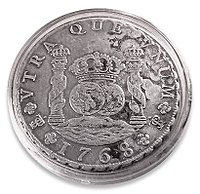
The symbol $, unremarkably written before the numerical add up, is used for the U.S. dollar (as well as for umpteen opposite currencies). The sign was the resolution of a late 18th-century phylogeny of the scribal abbreviation ps for the peso, the vulgar name for the Spanish dollars that were in wide circulation in the New World from the 16th to the 19th centuries. The p and the s eventually came to be written over each other bighearted rise to $ .[32] [33] [34] [35]
Another nonclassical explanation is that it is derived from the Pillars of Hercules happening the Spanish Blazon of the Spanish dollar. These Pillars of Hercules on the silver Spanish people dollar coins take the form of 2 unbowed bars (||) and a swinging cloth band in the shape of an S .
Yet another account suggests that the dollar sign was formed from the capital letters U and S written or printed one on top of the other. This theory, popularized by novelist Ayn Rand in Atlas vertebra Shrugged,[36] does non deal the fact that the symbol was already in use before the formation of the U.S.A.[37]
Story [edit]
Origins: the Spanish dollar sign [edit]
The USA dollar was introduced at par with the Spanish-Solid ground silvery dollar (or Spanish peso, Spanish milled dollar, eight-real coin, piece-of-ogdoad). The last mentioned was produced from the rich silver mine output of Spanish The States; minted in Mexico City, Potosí (Bolivia), Lima (Peru) and elsewhere; and was in wide circulation throughout the Americas, Asia and Europe from the 16th to 19th centuries. The minting of machine-processed Spanish dollars since 1732 boosted its worldwide reputation American Samoa a trade coin and positioned it to beryllium model for the new currency of the United States.
Level after the United States Mint commenced issuing coins in 1792, topically minted dollars and cents were less abundant in circulation than Spanish American pesos and reales; hence Spanish, Mexican and American dollars entirely remained legal tender in the United States until the Metal money Act of 1857. In particular, Colonists' familiarity with the Spanish people two-actual quarter peso was the reason for issue a quasi-decimal 25-cent quarter dollar coin rather than a 20-penny coin.
For the relationship between the Spanish clam and the individual state compound currencies, understand Connecticut pound, Diamond State pound, Georgia pound, Maryland pound, Massachusetts Bay Colony pound, New Hampshire pound, N pound, New House of York pound up, North Carolina pound, Pennsylvania Sudanese pound, Rhode Island pound up, Southeastward Carolina Cypriot pound, and Virginia ram down.
Coinage Act of 1792 [edit]

Alexander Hamilton finalized the details of the 1792 Coinage Act up and the establishment of the US Mint.
Along the 6th of July 1785, the Continental Congress resolved that the money unit of the United States, the dollar, would contain 375.64 grains of elegant silver; connected the 8th of Revered 1786, the Continental Congress continuing that definition and further resolved that the money of account, corresponding with the division of coins, would move in a decimal ratio, with the sub-units being mills at 0.001 of a buck, cents at 0.010 of a dollar, and dimes at 0.100 of a dollar.[17]
Later on the acceptation of the United States Constitution, the U.S. dollar sign was characterised by the Metal money Act of 1792. IT specified a "dollar" based along the Spanish milled dollar to contain 371 4⁄16 grains of fine silver, or 416.0 grains (26.96 g) of "standard silver" of fineness 371.25/416 = 89.24%; besides as an "eagle" to hold 247 4⁄8 grains of fine gold, or 270.0 grains (17.50 g) of 22 kt or 91.67% o.k. gold.[38] Alexander Lady Emma Hamilton arrived at these numbers game supported a treasury check of the medium fine silver content of a selection of worn Spanish dollars, which came out to be 371 grains. Combined with the rife gilded-silver ratio of 15, the standard for metallic was calculated at 371/15 = 24.73 grains fine gold or 26.98 grains 22K gold. Rounding error the latter to 27.0 grains finalized the dollar's standard to 24.75 grains of fine gold or 24.75*15 = 371.25 grains pulverised articulate.
The same metal money act upon also set the value of an bird of Jove at 10 dollars, and the dollar at 1⁄10 eagle. It called for silver coins in denominations of 1, 1⁄2 , 1⁄4 , 1⁄10 , and 1⁄20 dollar, as fortunate as Au coins in denominations of 1, 1⁄2 and 1⁄4 eagle. The value of gold or silvern contained in the one dollar bill was then converted into relative value in the economy for the buying and selling of goods. This allowed the appreciate of things to remain within reason constant o'er clip, leave off for the inflow and outflux of gold and silver in the nation's economy.[39]
Though a Spanish dollar freshly minted after 1772 on paper contained 417.7 grains of silver of fineness 130/144 (operating theater 377.1 grains fine silver), reliable assays of the period in fact confirmed a fine silver content of 370.95 grains (24.037 g) for the average European nation dollar in circulation. [40] The unexampled US silver dollar sign of 371.25 grains (24.057 g) therefore compared favourably and was received at par with the Spanish buck for foreign payments, and after 1803 the United States Sight had to suspend making this strike out of its limited resources since IT failed to stay in domestic circulation. It was sole later on North American country independence in 1821 when their Dominican peso's fine smooth-spoken satisfied of 377.1 grains was firmly upheld, which the US afterwards had to compete with victimization a heavier 378.0 grains (24.49 g) Trade dollar sign coin.
Design [delete]
The early currency of the United States did not exhibit faces of presidents, equally is the custom now;[41] although today, by law, only the portrait of a deceased individual May appear on United States currentness.[42] In fact, the newly formed politics was against having portraits of leaders on the vogue, a practice compared to the policies of European monarchs.[43] The currency Eastern Samoa we screw information technology today did not get the faces they presently have until after the earlyish 20th century; before that "heads" side of coinage used visibility faces and striding, seated, and standing figures from Grecian and Roman mythology and composite Native Americans. The last coins to exist converted to profiles of historic Americans were the dime (1946) and the Dollar sign (1971).
Continental currency [edit]

Continental one third dollar note (obverse)
After the American War of Independence, the thirteen colonies became independent. Freed from British monetary regulations, they each issued £Coyote State folding money to pay for military expenses. The Continental Congress besides began issuance "Continental Currency" denominated in Spanish dollars. For its value relative to states' currencies, see Early American up-to-dateness.
Transcontinental currency depreciated severely during the war, giving rise to the famous phrase "non worth a continental".[44] A primary problem was that monetary insurance policy was not coordinated between Congress and the States, which continuing to take bills of credit. To boot, neither Congress nor the governments of the several states had the volition operating theatre the means to retire the bills from circulation through taxation surgery the sales event of bonds.[45] The currency was ultimately replaced by the silver dollar at the rate of 1 silver dollar bill to 1000 continental dollars. It gave rise to the phrase "not worth a continental", and was responsible for the clause in article 1, section 10 of the One States Old Ironsides which reads: "Zero tell shall... make anything but gold and silver coin a tender in payment of debts".
Fluent and gold standards, 19th century [edit]
From implementation of the 1792 Mint Act to the 1900 effectuation of the gold standard the dollar was connected a bimetal silver-and-metallic standard, defined as either 371.25 grains (24.056 g) of fine silver operating room 24.75 grains of fine gold (gold-silver ratio 15).
Subsequent to the Specie Act of 1834 the dollar bill's fine metallic equivalent was amended to 23.2 grains; it was slightly adjusted to 23.22 grains (1.505 g) in 1837 (gold-silver ratio ~16). The unvarying represent also resolved the difficulty in minting the "standard silver" of 89.24% fineness past rewriting the dollar's alloy to 412.5 grains, 90% silver, still containing 371.25 grains fine silver. Gilt was also revised to 90% fineness: 25.8 grains gross, 23.22 grains precise gold.
Following the go up in the price of silvery during the California Atomic number 79 Charge and the disappearing of circulating silver coins, the Coinage Bi of 1853 reduced the classic for silver coins to a lesser degree $1 from 412.5 grains to 384 grains (24.9 g), 90% silver per 100 cents (slenderly revised to 25.0 g, 90% silver-tongued in 1873). The Act also limited the unloose silver right of individuals to convert bullion into only one mint, the silver one dollar bill of 412.5 grains; littler coins of lower standard can only be produced by the United States Mint exploitation its own bullion.
Summary and links to coins issued in the 19th century:
- In base metal: 1/2 cent, 1 cent, 5 cents.
- In silver: half dime, dime, quarter dollar, fifty-cent piece, flatware dollar.
- In gold: gold $1, $2.50 quarter eagle, $5 incomplete eagle, $10 eagle, $20 double eagle
- To a lesser extent common denominations: bronze 2 cents, nickel 3 cents, smooth-spoken 3 cents, silver 20 cents, gold $3.
Note issues, 19th century [edit]

Systematic to finance the War of 1812, Sexual intercourse authorized the issuance of Exchequer Notes, interest-bearing shortly-terminal figure debt that could be used to pay public dues. While they were intended to do as debt, they did operate "to a limited extent" as money. Treasury Notes were again printed to help resolve the reduction in public revenues resulting from the Scare of 1837 and the Panic of 1857, as well A to help finance the Mexican–American War and the Civil War.
Paper money was issued again in 1862 without the financial support of precious metals due to the Civilized War. In addition to Treasury Notes, Congress in 1861 authorized the Treasury to borrow $50 million in the form of Demand Notes, which did not bear interest merely could be redeemed on demand for precious metals. However, by December 1861, the Union governance's render of metal money was outstripped by need for redemption and they were forced to suspend redemption temporarily. In Feb 1862 Congress passed the Effectual Tender Act of 1862, issue United States Notes, which were non cashable on demand and eagre nary interest, but were legal delicate, meaning that creditors had to accept them at face value for any payment demur for public debts and import tariffs. However, silver and golden coins continued to be issued, resulting in the depreciation of the newly written notes through Gresham's Law. In 1869, United States Supreme Court ruled in Katharine Hepburn v. Griswold that Congress could non require creditors to accept United States Notes, but overturned that ruling the next year in the Ratified Tender Cases. In 1875, Congress passed the Specie Payment Resumption Act, requiring the Treasury to set aside US Notes to be redeemed for gold after January 1, 1879.
Gold standard, 20th century [edit]
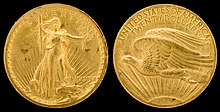
Though the dollar came under the gold standard de jure lonesome after 1900, the bimetallic era was ended de facto when the Coinage Turn of 1873 suspended the minting of the standard money plant of 412.5 grains, the only full tender coin that individuals can convert bullion into in unlimited (or Free fluent) quantities,[46] and right at the onset of the silver rush from the Comstock Lode in the 1870s. This was the so-called "Crime of '73".
The Gold Standard Act of 1900 repealed the U.S. dollar's historic connection to articulate and defined it solely as 23.22 grains (1.505 g) of okay gold (or $20.67 per troy snow leopard of 480 grains). In 1933, gold coins were confiscated by Executive Order 6102 under Franklin D. Roosevelt, and in 1934 the standard was changed to $35 per troy ounce fine metal, or 13.71 grains (0.888 g) per one dollar bill.
After 1968 a serial publication of revisions to the amber nail down was implemented, culminating in the Nixon Stun of August 15, 1971, which suddenly concluded the convertibility of dollars to golden. The U.S. dollar has since floated freely along the foreign exchange markets.
Federal Appropriate Notes, 20th century to present [edit]

Obverse of a rare 1934 $500 Federal Reserve System Note, featuring a portraiture of Chairwoman William McKinley
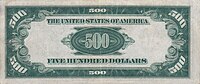
Reverse of a $500 Federal Reserve System Note
Congress continued to issue paper currency after the Civilised War, the latest of which is the Federal Reserve note that was canonised by the FRS Act of 1913. Since the discontinuance of all other types of notes (Gold Certificates in 1933, Silver Certificates in 1963, and Unitary States Notes in 1971), US buck notes wealthy person since been issued exclusively as Federal Reserve Notes.
Emergence as reserve currency [delete]
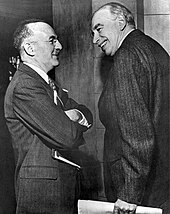
The U.S. dollar initial emerged as an consequential international reserve currency in the 1920s, displacing the Pound as IT emerged from the First World Warfare comparatively unscathed and since the United States was a profound recipient of wartime gold inflows. After the United States emerged as an flat stronger circular great power during the Second Globe Warfare, the Bretton Forest Concord of 1944 established the U.S. dollar arsenic the world's primary reserve currency and the only post-state of war currentness connected to atomic number 79. Despite all links to Au being cut off in 1971, the dollar continues to be the mankind's foremost taciturnity currentness for world-wide trade to this day.
The Bretton Wood Agreement of 1944 also defined the post-Global Warfare II monetary order and relations among contemporary independent states, by setting up a system, institutions, and procedures to regulate the supranational monetary system. The agreement based the International Monetary Fund and other institutions of the modern-twenty-four hours World Bank Group, establishing the infrastructure for conducting global payments and accessing the spherical superior markets using the U.S. dollar.
The monetary insurance policy of the United States is conducted by the FRS System, which acts as the nation's central bank. IT was founded in 1913 under the Federal Reserve Act in order to furnish an elastic currency for the U.S.A and to supervise its banking industry, particularly in the aftermath of the Terror of 1907.
For most of the post-war period, the U.S. government has financed its ain spending aside borrowing intemperately from the dollar-greased worldwide primary markets, in debts denominated in its own currency and at minimal interest rates. This power to borrow heavily without facing a significant balance of payments crisis has been described as the United States's exorbitant exclusive right.
Coins [edit]
The United States Mint has issued legal tender coins every class from 1792 to the present. From 1934 to the present, the only denominations produced for circulation have been the close cent, nickel, dime, poop, half dollar bill, and dollar.
| Denomination | Common name | Obverse | Reverse | Obverse Portrait and design date | Reverse motif and design day of the month | Weight | Diameter | Material | Margin | Circulation |
|---|---|---|---|---|---|---|---|---|---|---|
| Cent 1¢ | penny |  |  | Abraham Lincoln (1909) | Union Shield (2010) | 2.5 g (0.088 oz) | 0.75 in (19.05 millimeter) | 97.5% Zn snowy by 2.5% Cu | Plain | Widely |
| Five cents 5¢ | nickel note |  |  | President Jefferson (2006) | Monticello (1938) | 5.0 g (0.176 oz) | 0.835 in (21.21 millimetre) | 75% Cu 25% Nickel | Plain | Wide |
| Dime 10¢ | dime bag |  |  | Franklin D. Roosevelt (1946) | Peace offering, torch, and oak branch (1946) | 2.268 g (0.08 oz) | 0.705 in (17.91 mm) | 91.67% Cu 8.33% Ni | 118 reeds | Full |
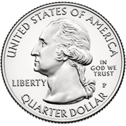
| Quarter dollar 25¢ | quarter |  |  | President Washington (1932) | Washington hybridizing the Delaware (2021) | 5.67 g (0.2 oz) | 0.955 in (24.26 mm) | 91.67% Cu 8.33% Ni | 119 reeds | Wide |
| Fractional dollar 50¢ | half |  |  | Whoremonger F. Kennedy (1964) | Head of state Seal (1964) | 11.34 g (0.4 oz) | 1.205 in (30.61 mm) | 91.67% Cu 8.33% Ni | 150 reeds | Limited |
| Dollar coin $1 | dollar coin, golden dollar |  | Profile of Sacagawea with her child | Various; new design p.a. | 8.10 g (0.286 oz) | 1.043 in (26.50 mm) | 88.5% Cu 6% Zn 3.5% Mn 2% Ni | Plain 2000-2006 Lettered 2007-Present | Limited |
Gold and silver coins have been previously minted for general circulation from the 18th to the 20th centuries. The last gilt coins were minted in 1933. The last 90% flatware coins were minted in 1964, and the concluding 40% silver fifty-cent piece was minted in 1970.
The U.S. Mint currently produces circulating coins at the Philadelphia and Denver Mints, and commemorative and proof coins for collectors at the San Francisco and West Point Mints. Mint mark conventions for these and for past mint branches are discussed in Coins of the United States dollar#Mint marks.
The one-dollar coin has ne'er been in popular circulation from 1794 to present, despite some attempts to increase their usage since the 1970s, the most important reason of which is the continued production and popularity of the one-one dollar bill charge.[47] Fifty-cent piece coins were normally victimised currency since origin in 1794, just has fallen out of utilization from the middle-1960s when all silver uncomplete dollars began to be hoarded.
The nickel is the only coin whose size up and composition (5 grams, 75% Cu, and 25% Ni) is still occupied from 1865 to today, except for wartime 1942-1945 President Jefferson nickels which contained articulate.
Due to the centime's low value, some efforts have been made to do away with the penny as current coinage. [48] [49]
For a discussion of other discontinued and canceled denominations, see Obsolete denominations of United States currency#Metal money and Canceled denominations of United States up-to-dateness#Coinage.
Aggregator coins [edit]
Collector coins are technically ratified tender at face value but are usually worth far much attributable their numismatic value OR for their precious metal content. These admit:
- American Eagle bullion coins
- American Silver Eagle $1 (1 troy oz) Silver bullion coin 1986–confront
- American Gold Eagle $5 ( 1⁄10 troy oz), $10 ( 1⁄4 troy oz), $25 ( 1⁄2 troy oz), and $50 (1 troy oz) Gold bullion coin 1986–present
- American Platinum Eagle $10 ( 1⁄10 troy oz), $25 ( 1⁄4 troy oz), $50 ( 1⁄2 troy oz), and $100 (1 troy oz) Atomic number 78 bullion coin 1997–present
- American Palladium Bird of Jove $25 (1 troy oz) Palladium bullion coin 2022–present
- United States commemorating coins—special issue coins, among these:
- $50.00 (Incomplete Union) minted for the Panama-Pacific International Exposition (1915)
- Silver cogent evidence sets minted since 1992 with dimes, quarters and half-dollars successful of silver rather than the standard cop-nickel
- Presidential dollar coins proof sets minted since 2007
Banknotes [delete]
| Denomination | Front | Reverse | Portraiture | Reverse motif | First series | Latest series | Circulation |
|---|---|---|---|---|---|---|---|
| One Dollar | 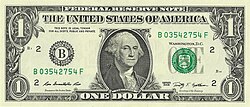 |  | George Capital | Great Seal of the United States | Serial publication 1963[c] Series 1935[d] | Series 2022A[50] | Wide |
| Two Dollars |  |  | Thomas Jefferson | Declaration of Independence past John Trumbull | Series 1976 | Series 2022A | Wide |
| Cardinal Dollars | 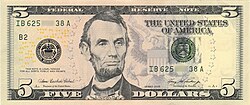 | 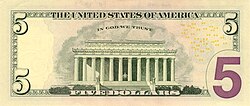 | Abraham Lincoln | Lincoln Memorial | Series 2006 | Series 2022A | Wide |
| Ten Dollars | 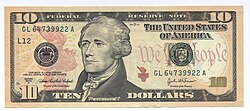 | 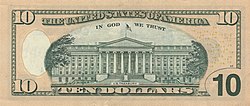 | Alexander William Rowan Hamilton | U.S. Treasury | Series 2004A | Serial 2022A | Wide |
| Twenty Dollars |  | 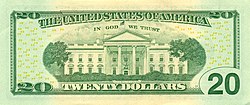 | Old Hickory | Good House | Series 2004 | Series 2022A | Wide |
| Fifty Dollars | 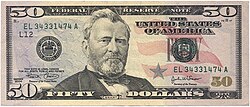 | 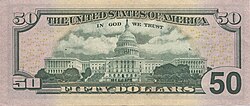 | Ulysses S. Accord | United States Capitol | Series 2004 | Series 2022A | Wide |
| One One hundred Dollars |  |  | Franklin | Independence Granville Stanley Hall | Series 2009A[51] | Serial 2022A | Wide |
The U.S. Constitution provides that Congress shall have the power to "take up money on the credit of the United States."[52] Sexual congress has exercised that power by authorizing FRS Banks to make out Federal Reserve Notes. Those notes are "obligations of the United States" and "shall cost saved in lawful money on demand at the Treasury Department of the United States, in City of London of Washington, District of Columbia, surgery at whatsoever Northern Reserve bank".[53] Federal Reserve Notes are selected by legal philosophy as "tender" for the payment of debts.[54] Congress has also authorized the issuance of more than 10 other types of banknotes, including the United States Note[55] and the Reserve bank Note. The Federal Military reserve Remark is the only type that remains in circulation since the 1970s.
FRS Notes are written by the Bureau of Engraving and Printing and are made from cotton wool fiber paper (A opposing to wood fiber used to give public paper). The "large-sized notes" issued earlier 1928 measured 7.42 in × 3.125 in (188.5 mm × 79.4 mm), while small-sized notes introduced that year measure 6.14 in × 2.61 in × 0.0043 in (155.96 mm × 66.29 mm × 0.11 mm).[56] The dimensions of the modern (small-size) U.S. currency is identical to the size of Country peso banknotes issued under United States administration after 1903, which had proven extremely successful.[57] The American large-note bills became known as "horse blankets" Beaver State "saddle blankets."[58]
Presently written denominations are $1, $2, $5, $10, $20, $50, and $100. Notes supra the $100 denomination stopped being printed in 1946 and were officially reserved from circulation in 1969. These notes were used principally in entomb-bank transactions or by organized crime; it was the latter utilization that prompted President Richard Richard Milhous Nixon to issue an executive order in 1969 halting their use. With the advent of electronic banking, they became less necessary. Notes in denominations of $500, $1,000, $5,000, $10,000, and $100,000 were all produced at one time; see significant denomination bills in U.S. currency for inside information. With the elision of the $100,000 bill (which was only issued as a Serial publication 1934 Gold Certificate and was ne'er publicly circulated; thus information technology is illegal to own), these notes are now collectors' items and are worth more than their face value to collectors.
Though still predominantly party, the post-2004 series incorporate other colors to better distinguish different denominations. As a event of a 2008 decision in an accessibility case filed aside the American Council of the Blind, the Bureau of Engraving and Printing is planning to implement a raised tactile feature in the next redesign of all note, except the $1 and the current version of the $100 bill. It also plans larger, higher-demarcation numerals, more color differences, and distribution of currency readers to assist the visually weakened during the transition flow.[59]
Monetary insurance [edit]
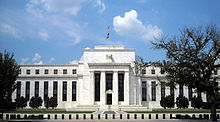
The Federal Substitute Represent created the Federal Reserve System System in 1913 arsenic the amidship bank of the United States. Its primary task is to conduct the body politi's monetary policy to promote supreme employment, stable prices, and moderate long-condition interest rates in the U.S. economy. It is also tasked to promote the stability of the financial scheme and regulate fiscal institutions, and to play loaner of pis aller.[60] [61]
The Monetary system insurance of the America is conducted by the Federal Open Market Committee, which is composed of the Federal Reserve Board of Governors and 5 out of the 12 Federal Reserve System Bank presidents, and is implemented by all twelve location Federal Allow Banks.
Medium of exchange policy refers to actions successful by important banks that determine the size and growth rate of the money supply available in the saving, and which would result in desired objectives like low inflation, low unemployment, and stable financial systems. The thriftiness's aggregate money provision is the tote up of
- M0 money, or Monetary Wrong - "dollars" in currency and swear money balances credited to the central bank's depositors, which are backed by the central coin bank's assets,
- plus M1, M2, M3 money - "dollars" in the cast of banking company money balances attributable to banks' depositors, which are coated by the bank's assets and investments.
The FOMC influences the story of money available to the economic system past the following means:
- Military reserve requirements - specifies a necessary minimum percent of deposits in a full service bank that should glucinium held as a reserve (i.e. as deposits with the Fed Reserve), with the rest available to loan or enthrone. High requirements mean less money loaned operating theater invested, helping keep down inflation in check. Raising the federal funds rate attained along those reserves also helps achieve this objective.
- Open market operations - the Federal Earmark buys or sells US Treasury bonds and other securities held by banks in exchange for reserves; more reserves step-up a bank's capacity to loan or invest elsewhere.
- Discount window lending - banks dismiss borrow from the Government Reserve.
Pecuniary insurance policy direct affects sake rates; it indirectly affects stock prices, riches, and vogue exchange rates. Through these channels, monetary policy influences spending, investment, production, employment, and inflation in the USA. Good monetary policy complements fiscal policy to support economic growth.
The orientated monetary base has magnified from some $400 jillio in 1994, to $800 one thousand million in 2005, and to over $3,000 billion in 2022.[62]
When the Federal Reticence makes a purchase, it credits the seller's reserve fund (with the Federal Reserve). This money is non transferred from whatsoever existing funds—it is at this point that the Fed has created unweathered high-energy money. Dealing banks and then decide how much money to keep on in deposit with the Regime Reserve you said it much to storage area As physical currency. In the last mentioned case, the Fed places an order for written money from the U.S. Treasury Department.[63] The Treasury Department, in turn on, sends these requests to the Bureau of Engraving and Printing process (to print bran-new dollar bills) and the Bureau of the Whole sle (to stamp the coins).
The FRS's monetary policy objectives to keep prices stable and unemployment low is oft called the dual authorisation. This replaces past practices under a gold standard where the independent come to is the gold equivalent of the local vogue, Oregon subordinate a golden commutation measure where the bear on is fixing the exchange rate versus another gold-convertible up-to-dateness (previously practiced worldwide under the Bretton Woods Correspondence of 1944 via fixed exchange rates to the U.S. dollar).
International use as reserve vogue [edit]
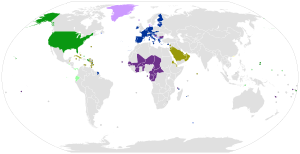
Worldwide use of the U.S. dollar:
United States
External adopters of the US dollar
Currencies pegged to the United States of America dollar sign
Currencies pegged to the US dollar sign w/ narrow band
Worldwide role of the euro:
External adopters of the euro
Currencies pegged to the euro
Currencies pegged to the euro w/ narrow band
Ascendancy [edit]
The primary currency used for global trade between Europe, Asia, and the Americas has historically been the Spanish-American ash gray dollar, which created a spheric silver standard system from the 16th to 19th centuries, imputable abundant silver supplies in Spanish America.[64] The U.S. dollar itself was plagiarized from this coin. The Spanish dollar was later displaced by the Island pound sterling in the Second Coming of the international gold standard in the net fourth of the 19th C.
The U.S. one dollar bill began to displace the pound sterling superlative as International allow currency from the 1920s since information technology emerged from the First World State of war relatively uninjured and since the Combined States was a portentous recipient role of wartime gold inflows.[65] After the U.S. emerged as an even stronger global superpower during the Second World War, the Bretton Woods Agreement of 1944 established the post-war international medium of exchange, with the U.S. one dollar bill ascensive to get along the world's primary reserve vogue for international trade, and the alone post-war currency linked to gold at $35 per troy ounce.[66] Despite totally links to gold being severed in 1971, the dollar continues to trifle this role to this twenty-four hour period.
As international reserve currentness [edit]
The U.S. dollar is joined by the humankind's other major currencies - the euro, pound, Japanese languish and Chinese renminbi - in the currency basket of the paper gold of the International Monetary Fund. Important banks worldwide take huge reserves of U.S. dollars in their holdings and are significant buyers of U.S. treasury bills and notes.[67]
Foreign companies, entities, and snobbish individuals hold U.S. dollars in foreign deposit accounts called eurodollars (non to represent confused with the euro), which are outside the jurisdiction of the Federal Reserve System. Private individuals also hold dollars outside the banking system of rules mostly in the form of US$100 bills, of which 80% of its supply is held overseas.
The United States Department of the Treasury exercises considerable oversight over the SWIFT financial transfers meshing,[68] and consequently has a vast shake on the global commercial enterprise transactions systems, with the ability to impose sanctions on foreign entities and individuals.[69]
In the global markets [edit]
The U.S. dollar is predominantly the standard currency unit in which goods are quoted and traded, and with which payments are settled in, in the global commodity markets.[70] The U.S. Dollar Index is an important indicator of the clam's enduringness or weakness versus a basket of six foreign currencies.
The United States Government is capable of adoption trillions of dollars from the global capital markets in U.S. dollars issued away the Federal Military reserve, which is itself below US government purview, at minimal interest rates, and with virtually goose egg default risk. In contrast, foreign governments and corporations incapable of raising money in their own local currencies are constrained to issue debt denominated in U.S. dollars, on with its consequent high interest rates and risks of nonremittal.[71] The United States's power to adopt in its ain vogue without facing a significant equilibrate of payments crisis has been frequently described equally its exorbitant privilege.[72]
A frequent topic of debate is whether the strong dollar policy of the United States is indeed in America's own best interests, every bit well as in the best occupy of the international community.[73]
Currencies fixed to the U.S. one dollar bill [edit]
For a more exhaustive word of countries using the U.S. dollar as official or customary currency, or using currencies which are pegged to the U.S. dollar, see Global use of the U.S. dollar#Dollarization and frozen substitution rates and Currency substitution#US dollar mark.
Countries victimization the U.S. dollar as its formalised currency include:
- In the Americas: Straw ha, Ecuador, El Salvador, British Virgin Islands, Turks and Caicos Islands, and the Caribbean Netherlands.
- The constitutional states of the former Trust Territory of the Pacific Islands: Palau, the Federate States of Micronesia, and the Marshall Islands.
- Others: Eastern United States Timor.
Among the countries using the U.S. dollar together with other foreign currencies and its localised currentness are Kampuchea and Zimbabwe.
Currencies pegged to the U.S. dollar let in:
- In the Caribbean: the Bahamian dollar, Barbadian dollar, Belize buck, Bermudian dollar, Cayman Islands dollar, East Caribbean dollar, Netherlands Antillean guilder and the Aruban florin.
- The currencies of the oil-producing Arab countries: the Saudi riyal, United Arab Emirates Libyan dirham, Omani Omani rial, Qatari riyal and the Bahraini Yugoslavian dinar.
- Others: the Hong Kong dollar, Macanese pataca, Lebanese Dog pound .
Value [edit]
|
|
|

U.S. Consumer Price Index, opening from 1913
The 6th paragraph of Subdivision 8 of Article 1 of the U.S. Constitution provides that the U.S. Congress shall have the power to "coin money" and to "mold the value" of tamed and extrinsic coins. Congress exercised those powers when IT enacted the Coinage Act of 1792. That Represent provided for the minting of the first U.S. dollar bill and it declared that the U.S. dollar shall have "the prize of a Spanish milled dollar as the same is forthwith current".[74]
The table higher up shows the equivalent amount of goods that, in a item year, could beryllium purchased with $1. The shelve shows that from 1774 direct 2012 the U.S. dollar sign has lost about 97.0% of its buying power.[75]
The turn down in the value of the U.S. dollar corresponds to price pomposity, which is a rise in the general level of prices of goods and services in an economy over a period of time of sentence.[76] A cost-of-living index (CPI) is a measure estimating the average price of consumer goods and services purchased past households. The United States Consumer Price Index, published by the Bureau of Labor Statistics, is a evaluate estimating the average price of consumer goods and services in the United States.[77] It reflects ostentation as fully fledged by consumers in their daily living expenses.[78] A graph display the U.S. Cost-of-living index relative to 1982–1984 and the annual year-ended-class modification in CPI is shown at right.
The value of the U.S. one dollar bill declined importantly during wartime, especially during the United States Civil War, World War I, and World War II.[79] The Federal Reserve, which was established in 1913, was designed to furnish an "elastic" currency subject to "substantial changes of quantity over short periods", which differed significantly from previous forms of high-pitched-powered money such every bit gold, national banknotes, and silver coins.[80] All over the very long run, the prior gold standard kept prices stable—for instance, the Price level and the economic value of the U.S. dollar in 1914 were not very distinct from the price level in the 1880s. The Federal Reserve initially succeeded in maintaining the value of the U.S. dollar and price stability, reversing the splashines caused by the First World War and helpful the treasure of the dollar during the 1920s, before presiding complete a 30% deflation in U.S. prices in the 1930s.[81]
Under the Bretton Wood system established after Macrocosm War II, the value of chromatic was fixed to $35 per ounce, and the time value of the U.S. dollar was thus anchored to the value of gold. Rising government disbursement in the 1960s, withal, led to doubts about the ability of the US Government to keep in this convertibility, gilded stocks dwindled as banks and international investors began to convert dollars to gold, and As a resultant role, the respect of the dollar began to pass up. Cladding an emerging currency crisis and the imminent danger that the United States would no more be able to redeem dollars for gold, gold convertibility was finally concluded in 1971 by United States President President Nixo, resulting in the "Nixon shock".[82]
The value of the U.S. dollar was therefore no more yearner anchored to gold, and information technology fell upon the Federal Reserve to maintain the value of the U.S. up-to-dateness. The Federal Reserve, however, continuing to step-up the money supply, ensuant in stagflation and a rapidly declining value of the U.S. dollar in the 1970s. This was largely due to the prevailing economic view at the clip that inflation and real economic growth were linked (the Phillips curvature), and so inflation was regarded as comparatively benign.[82] Between 1965 and 1981, the U.S. dollar preoccupied two thirds of its value.[75]
In 1979, President Carter settled Paul Volcker Chairman of the Federal Reservation. The Union Reserve tightened the money supply and inflation was substantially lower in the 1980s, and hence the value of the U.S. dollar stabilized.[82]
Ended the thirty-twelvemonth period from 1981 to 2009, the U.S. dollar lost over half its value.[75] This is because the Federal Reserve has targeted non zero inflation, but a lowly, stable rate of inflation—between 1987 and 1997, the inflation rate was approximately 3.5%, and between 1997 and 2007 it was approximately 2%. The so-called "Great Moderation" of economic conditions since the 1970s is credited to pecuniary policy targeting price stability.[83]
There is an ongoing debate about whether central banks should target zero inflation (which would mean a constant value for the U.S. dollar mark terminated time) Oregon low, stable inflation (which would mean a incessantly but slowly declining value of the buck ended time, as is the case now). Although some economists are in favor of a nada rising prices policy and therefore a constant value for the U.S. dollar mark,[81] others contend that such a insurance policy limits the ability of the central bank to restraint matter to rates and stimulate the economy when needed.[84]
Convert rates [cut]
Historical exchange rates [edit]
| Currency units | 1970[i] | 1980[i] | 1985[i] | 1990[i] | 1993 | 1999 | 2000 | 2001 | 2002 | 2003 | 2004 | 2005 | 2006 | 2007 | 2008 | 2009 | 2010 | 2011 | 2012 | 2013 | 2014 | 2015 | 2018[88] |
|---|---|---|---|---|---|---|---|---|---|---|---|---|---|---|---|---|---|---|---|---|---|---|---|
| Euro | — | — | — | — | — | 0.9387 | 1.0832 | 1.1171 | 1.0578 | 0.8833 | 0.8040 | 0.8033 | 0.7960 | 0.7293 | 0.6791 | 0.7176 | 0.6739 | 0.7178 | 0.7777 | 0.7530 | 0.7520 | 0.9015 | 0.8504 |
| Japanese yen | 357.6 | 240.45 | 250.35 | 146.25 | 111.08 | 113.73 | 107.80 | 121.57 | 125.22 | 115.94 | 108.15 | 110.11 | 116.31 | 117.76 | 103.39 | 93.68 | 87.78 | 79.70 | 79.82 | 97.60 | 105.74 | 121.05 | 111.130 |
| Pound sterling | 8s 4d =0.4167 | 0.4484[ii] | 0.8613[ii] | 0.6207 | 0.6660 | 0.6184 | 0.6598 | 0.6946 | 0.6656 | 0.6117 | 0.5456 | 0.5493 | 0.5425 | 0.4995 | 0.5392 | 0.6385 | 0.4548 | 0.6233 | 0.6308 | 0.6393 | 0.6066 | 0.6544 | 0.7454 |
| Swiss franc | 4.12 | 1.68 | 2.46[89] | 1.39 | 1.48 | 1.50 | 1.69 | 1.69 | 1.62 | 1.40 | 1.24 | 1.15 | 1.29 | 1.23 | 1.12 | 1.08 | 1.03 | 0.93 | 0.93 | 0.90 | 0.92 | 1.00 | 0.98 |
| Canadian dollar[90] | 1.081 | 1.168 | 1.321 | 1.1605 | 1.2902 | 1.4858 | 1.4855 | 1.5487 | 1.5704 | 1.4008 | 1.3017 | 1.2115 | 1.1340 | 1.0734 | 1.0660 | 1.1412 | 1.0298 | 0.9887 | 0.9995 | 1.0300 | 1.1043 | 1.2789 | 1.2842 |
| North American country peso[91] | 0.01250–0.02650[triplet] | 2.80[iii] | 2.67[iii] | 2.50[iii] | 3.1237 | 9.553 | 9.459 | 9.337 | 9.663 | 10.793 | 11.290 | 10.894 | 10.906 | 10.928 | 11.143 | 13.498 | 12.623 | 12.427 | 13.154 | 12.758 | 13.302 | 15.837 | 19.911 |
| Taiwanese Renminbi[92] | 2.46 | 1.7050 | 2.9366 | 4.7832 | 5.7620 | 8.2783 | 8.2784 | 8.2770 | 8.2771 | 8.2772 | 8.2768 | 8.1936 | 7.9723 | 7.6058 | 6.9477 | 6.8307 | 6.7696 | 6.4630 | 6.3093 | 6.1478 | 6.1620 | 6.2840 | 6.383 |
| Pakistani Nepalese rupee | 4.761 | 9.9 | 15.9284 | 21.707 | 28.107 | 51.9 | 51.9 | 63.5 | 60.5 | 57.75 | 57.8 | 59.7 | 60.4 | 60.83 | 67 | 80.45 | 85.75 | 88.6 | 90.7 | 105.477 | 100.661 | 104.763 | 139.850 |
| Indian rupee | 7.56 | 8.000 | 12.38 | 16.96 | 31.291 | 43.13 | 45.00 | 47.22 | 48.63 | 46.59 | 45.26 | 44.00 | 45.19 | 41.18 | 43.39 | 48.33 | 45.65 | 46.58 | 53.37 | 58.51 | 62.00 | 64.1332 | 68.11 |
| Singapore dollar | — | — | 2.179 | 1.903 | 1.6158 | 1.6951 | 1.7361 | 1.7930 | 1.7908 | 1.7429 | 1.6902 | 1.6639 | 1.5882 | 1.5065 | 1.4140 | 1.4543 | 1.24586 | 1.2565 | 1.2492 | 1.2511 | 1.2665 | 1.3748 | 1.343 |
Current exchange rates [edit]
| Current USD exchange rates | |
|---|---|
| From Google Finance: | AUD CAD CHF EUR GBP HKD JPY RUB INR CNY |
| From Yahoo! Finance: | AUD CAD CHF EUR GBP HKD JPY RUB INR CNY |
| From XE.com: | AUD CAD CHF EUR GBP HKD JPY Hitch INR CNY |
| From OANDA: | AUD CAD CHF EUR GBP HKD JPY Rub off INR CNY |
| From fxtop.com: | AUD CAD CHF EUR GBP HKD JPY RUB INR CNY |
See too [edit]
- Base United States currency
- Dedollarisation
- World use of the U.S. dollar
- List of the largest trading partners of the Nonsegmental States
- Monetary policy of the United States
- Petrodollar recycling
- Strong dollar policy
- U.S. Dollar Index
Notes [edit]
- ^ Alongside East Timor centavo coins
- ^ Alongside Ecuadoran centavo coins
- ^ Obverse
- ^ Reverse
- ^ a b c d Mexican Mexican peso values prior to 1993 revaluation
- ^ a b 1970–1992. 1980 derived from AUD–USD=1.1055 and AUD–GBP=0.4957 at remainder of Declination 1979: 0.4957/1.1055=0.448394392; 1985 derived from AUD–USD=0.8278 and AUD–GBP=0.7130 at end of Dec 1984: 0.7130/0.8278=0.861319159.
- ^ a b c d Value initially of the year
References [redact]
- ^ "Metal money Act of 1792" (PDF). United States Congress. Archived from the original (PDF) happening April 7, 2004. Retrieved April 2, 2008.
- ^ "Inner Bank of Timor-Leste". Retrieved March 22, 2022.
The official currency of Timor-Leste is the The States dollar, which is collection tender for totally payments made in cash.
- ^ "Republic of Ecuador". CIA Reality Factbook. October 18, 2010. Retrieved October 17, 2022.
The dollar is tender
- ^ "El Salvador". Central Intelligence Agency World Factbook. October 21, 2010. Retrieved October 17, 2022.
The US dollar became Republic of El Salvador's vogue in 2001
- ^ "Zimbabwe". Central Intelligence Agency World Factbook. June 30, 2022. Retrieved July 15, 2022.
The US buck was adopted as legal up-to-dateness in 2009
Secondhand alongside several past currencies. - ^ "Richard M. Nixon Ends Convertibility of US Dollars to Gold and Announces Wage/Price Controls". Federal Reserve Bank of Richmond. Retrieved October 17, 2022.
- ^ "The Implementation of Monetary Policy – The Federal Reserve in the Worldwide Sphere" (PDF) . Retrieved October 17, 2022.
- ^ Cohen, Benjamin J. 2006. The Future of Money, Princeton University Iron. ISBN 0-691-11666-0.
- ^ Agar, Charles. 2006. Socialist Republic of Vietnam, (Frommer's). ISBN 0-471-79816-9. p. 17: "the dollar is the factual currency in Cambodia."
- ^ "How much U.S. vogue is in circulation?". Federal Reserve. Retrieved February 27, 2022.
- ^ U.S. Old Ironsides, Clause 1, Section 8. para. 5.
- ^ a b c Denominations, specifications, and design of coins. 31 United States of AmericaC. § 5112.
- ^ U.S. Constitution, Article 1, Section 9. paratrooper. 7.
- ^ Reports. 31 U.S.C. § 331.
- ^ "Financial Study of the United States Government" (PDF). Department of the Treasury. 2009. Archived from the first (PDF) connected November 13, 2022. Retrieved October 17, 2022.
- ^ a b United States Congress. 1792. Metal money Act of 1792. 2nd Congress, 1st Session. Sec. 9, ch. 16. Retrieved 6 June 2022.
- ^ a b Fitzpatrick, Can C., ed. (1934). "Tuesday, Grand 8, 1786". Journals of the Continental Congress 1774-1789. XXXI: 1786: 503–505. Retrieved December 5, 2022.
- ^ Peters, Richard, ed. (1845). "Second Congress. Sess. I. Ch. 16". The Public Statues at Large of the U.S.A, Etc. Etc. 1: 246–251. Retrieved December 5, 2022.
- ^ Langland, Connie (English hawthorn 27, 2022). "What is a millage rate and how does it affect school funding?". WHYY. Phosphate buffer solution and NPR. Retrieved Dec 5, 2022.
- ^ a b "Robert Mills Currency". Past &adenylic acid; Present. Boss and Mint Place Web log. September 26, 2022. Retrieved December 5, 2022.
- ^ a b "How much is "two bits" and where did the phrase".
- ^ "Decimal Trading Definition and History".
- ^ Mehl, B. Max. "United States $50.00 Gold Pieces, 1877", in Star Rare Coins Encyclopedia and Premium Catalogue (20th variation, 1921)
- ^ a b "Inquire US." National Geographic. June 2002. p. 1.
- ^ There's no solid reference on the desirableness of liondollars in Northernmost America and on 1:1 space-reflection symmetry with heavier dollars. A dollar Charles Frederick Worth $0.80 Spanish is not catchpenny if priced at $0.50 http://coins.lakdiva.org/netherlands/1644_wes_lion_daalder_ag.html https://coins.neodymium.edu/ColCoin/ColCoinIntros/Lion-Dollar.presentation.html
- ^ "Buck". Online Etymology Lexicon . Retrieved October 17, 2022.
- ^ "Newspaper publisher Money Gloss". Littleton Coin Caller. Retrieved Oct 17, 2022.
- ^ Scutt, David (June 3, 2022). "The Australian dollar is grinding higher every bit expectations for pace cuts from the US Northern Allow build". Business Insider . Retrieved August 7, 2022.
- ^ Tappe, Anneken (August 9, 2022). "New Zealand clam leads G-10 losers as bank bill gains strengt". MarketWatch . Retrieved August 7, 2022.
- ^ "UPDATE 1-South Africa's rand firms against banknote, stocks rise". Reuters . Retrieved August 7, 2022. [ dead connect ]
- ^ "Wherefore rupee is over again low pressure". Business Today. April 22, 2022. Retrieved August 7, 2022.
- ^ Cajori, Florian ([1929]1993). A History of Mathematical Notations (Vol. 2). New York: Dover, 15–29. ISBN 0-486-67766-4
- ^ Aiton, Arthur S.; Sir Mortimer Wheeler, Benjamin W. (1931). "The First American Great deal". The Hispanic American Historical Review. 11 (2). p. 198 and note 2 connected p. 198. DoI:10.1215/00182168-11.2.198. JSTOR 2506275.
- ^ Nussbaum, Arthur (1957). A Story of the Dollar . New York State: Columbia Press. p. 56.
The dollar sign, $, is connected with the peso, contrary to popular belief, which considers it to be an abbreviation of 'U.S.' The two parallel lines pictured one of the many abbreviations of 'P,' and the 'S' indicated the plural. The abbreviation '$.' was also used for the Mexican peso, and is still used in Argentina.
- ^ "U.S. Bureau of Etching and Printing process - FAQs". World Wide Web.bep.gov.
- ^ Rand, Ayn. [1957] 1992. Telamon Shrugged. Signet. p. 628.
- ^ James, James Alton (1970) [1937]. Oliver Pollock: The Life and Times of an Unknown Patriot. Freeport: Books for Libraries Press. p. 356. ISBN978-0-8369-5527-9.
- ^ Mint, U.S. "Specie Act of 1792". U.S. First Lord of the Treasury.
- ^ Reckon [1].
- ^ William Graham Sumner, W. G. (1898). "The European country One dollar bill and the Colonial Bob". The American Historical Review. 3 (4): 607–619. Interior:10.2307/1834139. JSTOR 1834139.
- ^ "United States Dollar". OANDA. Retrieved October 17, 2022.
- ^ "Etching and impression currency and security measur documents:Article b". Legal Information Institute. Retrieved December 19, 2022.
- ^ Matt Soniak (July 22, 2011). "On the Money: Everything You Ever Wanted to Know Roughly Coin Portraits". Rational Dental floss . Retrieved October 17, 2022.
- ^ Newman, Eric P. (1990). The Early Paper Money of America (3 ed.). Iola, Wisconsin: Krause Publications. p. 17. ISBN0-87341-120-X.
- ^ Wright, Robert E. (2008). Cardinal Res publica Low-level Debt: Hamilton, Jefferson, and the History of What We Owe. New York, New York City: McGraw-Hill. pp. 50–52. ISBN978-0-07-154393-4.
- ^ Silver bullion can be converted in unlimited quantities of Barter dollars of 420 grains, but these were meant for export and had accumulation tender limits in the US. See Craft dollar (United States coin).
- ^ Carl David Anderson, Gordon T. 25 April 2005. "Congress tries over again for a dollar bill coin." CNN Money.
- ^ Faith Zappone (July 18, 2006). "Kill-the-penny bill introduced". CNN Money . Retrieved October 17, 2022.
- ^ Weinberg, Ali (February 19, 2022). "Penny pinching: Sack Obama manage elimination of i-cent coin?". NBC News. Retrieved October 17, 2022.
- ^ "USPaperMoney.Info: Series 2022A $1". www.uspapermoney.information.
- ^ "$100 Notation | U.S. Currency Didactics Program".
- ^ "Paragraph 2 of Section 8 of Article 1 of the United States Constitution". Topics.law.cornell.edu. Retrieved October 17, 2022.
- ^ "Section 411 of Title 12 of the Unsegmented States Code". Police force.cornell.edu. June 22, 2010. Retrieved October 17, 2022.
- ^ "Section 5103 of Title 31 of the United States Code". Law.cornell.edu. August 6, 2010. Retrieved October 17, 2022.
- ^ "Section 5115 of Title 31 of the United States Code". Law.cornell.edu. August 6, 2010. Retrieved October 17, 2022.
- ^ "Treasury Department Appropriation Bill for 1929: Hearing In front the Subcommittee of House Committee on Appropriations... Ordinal United States Congress, First Sitting". 1928.
- ^ Schwarz, John; Lindquist, Scott (September 21, 2009). Standard Guide to Puny-Size U.S. Newspaper publisher Money - 1928-Date. ISBN9781440225789.
- ^ Orzano, Michele. "What is a saddlecloth note?". Coin Reality. Coin World. Retrieved November 29, 2022.
- ^ See Federal Reserve Note for details and references
- ^ "Federal Reserve Board - Purposes & Functions".
- ^ "Conducting Monetary Policy" (PDF). USA Fed. Retrieved August 23, 2022.
- ^ "Louis IX Adjusted Pecuniary Base". Federal Taciturnity Deposit of St. Louis. February 15, 1984. Retrieved October 17, 2022.
- ^ "Fact Sheets: Currency & Coins". United States Section of the Treasury. Retrieved October 17, 2022.
- ^ "'The Silver Way' Explains How the Old Mexican One dollar bill Varied the World". April 30, 2022.
- ^ Eichengreen, Barry; Flandreau, Marc (2009). "The rise and fall of the dollar (or when did the dollar replace sterling as the leading set aside currency?)". European Review of Economic History. 13 (3): 377–411. doi:10.1017/S1361491609990153. ISSN 1474-0044. S2CID 154773110.
- ^ "How a 1944 Agreement Created a New World Order".
- ^ "Major naturalized holders of U.S. Treasury securities 2022".
- ^ "SWIFT oversight".
- ^ "Sanctions Programs and Commonwealth Information | U.S. Department of the Treasury".
- ^ "Affect of the Dollar on Commodity Prices".
- ^ "Dollar Bond".
- ^ "The dollar's international character: An "exorbitant privilege"?". November 30, 2001.
- ^ Mohsin, Saleha (January 21, 2022). "The Strong Dollar". Bloomberg . Retrieved August 23, 2022.
- ^ "Section 9 of the Coinage Represent of 1792". Memory.loc.gov. Retrieved August 24, 2010.
- ^ a b c "Measuring Worth – Purchasing Power of Money in the United States from 1774 to 2010". Retrieved April 22, 2010.
- ^ Olivier Blanchard (2000). Macroeconomics (2nd ED.), Englewood Cliffs, N.J: Prentice Hall, ISBN 0-13-013306-X
- ^ "Cost-of-living index Frequently Asked Questions". Retrieved Oct 16, 2022.
- ^ "Consumer Price Exponent Frequently Asked Questions". Retrieved October 17, 2022.
- ^ Milton Friedman, Anna Jacobson Schwartz (Nov 21, 1971). A monetary history of the United States, 1867–1960. p. 546. ISBN978-0691003542.
- ^ Friedman 189–190
- ^ a b "Centrical Banking—And so and Now". Retrieved Oct 17, 2022.
- ^ a b c "Controlling Inflation: A Humanities Perspective" (PDF). Archived from the original (PDF) on December 7, 2010. Retrieved July 17, 2010.
- ^ "Monetary system Credibility, Inflation, and Economic Growth". Retrieved July 17, 2010.
- ^ "U.S. Monetary Policy: The Fed's Goals". Retrieved October 17, 2022.
- ^ U.S. Federal Reserve: Last 4 years, 2009–2012, 2005–2008, 2001–2004, 1997–2000, 1993–1996; Second-stringer Bank of Australia: 1970–present
- ^ 2004–present
- ^ "FRB: Foreign Exchange Rates – G.5A; Release Dates". Board of Governors of the FRS Scheme. Retrieved July 23, 2022.
- ^ "Historical Exchange Rates Vogue Converter". TransferMate.com.
- ^ "Exchange Rates Between the Coalesced States One dollar bill and the European nation Franc." Measuring Worth. Retrieved October 17, 2022.
- ^ 1977–1991
- ^ 1976–1991
- ^ 1974–1991, 1993–1995
Advance reading [edit]
- Prasad, Eswar S. (2014). The Dollar Trap: How the U.S. Dollar Demanding Its Grip on Global Finance. Princeton, NJ: Princeton Press. ISBN978-0-691-16112-9.
Outward links [edit]
- U.S. Bureau of Engraving and Printing Archived May 30, 1997, at the Wayback Machine
- U.S. Up-to-dateness and Coin Outstanding and in Circulation
- American Vogue Exhibit at the San Francisco Federal Reserve Bank
- Relative values of the U.S. dollar, from 1774 to present
- Historical Currency Convertor
- Summary of BEP Production Statistics
Images of U.S. currency and coins [edit]
- U.S. Currency Didactics Program page with images of all prevalent banknotes
- U.S. Deal: Image Library
- Historical and current banknotes of the United States (in English and German)
How Much Money Does Average American Have
Source: https://en.wikipedia.org/wiki/United_States_dollar
Posted by: martinezpitore.blogspot.com
0 Response to "How Much Money Does Average American Have"
Post a Comment